How Income-Based Apartment Approval Works
How income multiples, proof of income, and DTI get low-credit renters approved in Austin, and how a locator matches you to income-focused communities.

We see hundreds of applications every week, and the biggest point of stress is always a credit score sitting below that standard 620 line.
That single number causes many property managers to automatically reject perfectly good renters. Fortunately, income based apartment approval Austin policies provide a highly effective alternative if you have a steady paycheck. Our apartment locators focus on finding communities that weigh your actual earnings much more heavily than past financial mistakes.
This specific method means a solid 2.5x to 3x income-to-rent calculation can clear screening at properties that turn away applicants with flawless credit but lower salaries. Let’s examine exactly how this mechanism works in 2026 and what documentation you need to succeed.
The income-to-rent ratio
We always tell applicants that the single most important number is the gross monthly income to monthly rent ratio. The word “gross” simply means your total earnings before taxes and deductions. Most communities calculate this figure directly from your pay stubs rather than looking at your bank account balance.
Our team recommends reviewing these standard thresholds before you start touring:
- 2.5x rent at the most flexible end (mostly income-focused communities)
- 3x rent at the standard end (most mid-tier and Class A properties)
- 3.5x rent at the strictest end (sometimes applied to bad-credit applicants specifically)
Texas tenant screening laws updated in 2025 now require landlords to provide these exact ratio criteria in writing before they collect a fee. You must receive and sign this disclosure document to protect yourself from losing money on hidden requirements.
We base our math on the current market, where the average rent for an Austin one-bedroom sits around $1,650 in 2026. For a slightly cheaper $1,400 per month apartment, the math breaks down clearly. The table below shows exactly what you need to earn gross each month to qualify:
| Required Ratio | Minimum Gross Monthly Income | Typical Property Type |
|---|---|---|
| 2.5x | $3,500 | Flexible screening communities |
| 3.0x | $4,200 | Standard mid-tier apartments |
| 3.5x | $4,900 | Stricter properties for low credit |
How income substitutes for credit
We frequently see communities configure their screening algorithms so that you can literally rent on income not credit. Modern property management software evaluates your overall risk profile rather than just looking at a flat FICO number. A recent 2026 analysis of Austin screening trends shows that managers often overlook a 540 score if your recent payment history looks clean and your income is exceptionally high.
Our partners use a sliding scale formula to determine risk for most second-chance properties. The math roughly looks like this across the city:
| Credit Score | Required Income Ratio | Property Match |
|---|---|---|
| 540 | 3.5x Gross Income | Many flexible communities |
| 580 | 3.0x Gross Income | Standard income-focused properties |
| 620 | 2.5x Gross Income | Most flexible-screening apartments |
The secret to success is clearing at least one of these bars at a very high level.
We know that either your credit needs to clear the minimum floor, or your income must be large enough to act as a safety net. In the best-case scenario, you bring both to the table. You can find more details on how communities balance these factors by reading our guide on credit score vs income in apartment screening.
What counts as income
We help applicants document a wide variety of revenue streams because a standard W-2 is not the only way to qualify. Most flexible communities accept several verified sources of funds. The acceptable categories typically include:
- W-2 employment income (Requires official pay stubs)
- 1099 or self-employment income (Requires tax returns and bank statements)
- Social Security or disability benefits (Requires the official award letter)
- Pension and retirement income (Requires a 1099-R or benefit statement)
- Child support or alimony (Requires a court order plus a consistent deposit history)
- Housing Choice Voucher (Requires a Section 8 award letter and counts toward the rent calculation)
- Spousal or partner income (Only counts if they are legally listed on the lease)
Our screening experts want you to know exactly what managers will reject so you do not waste an application fee. A significant number of flexible communities will explicitly deny applications relying on the following sources:
- Unreported cash income
- Friends’ or family members’ income (unless they apply as formal co-applicants)
- Pending or future income (a job offer alone is usually weaker than four actual weeks of pay stubs)
- One-off lump sums like tax refunds or severance packages that lack monthly stability
Advanced document screening tools like Snappt and Verifast are now standard across Austin apartments in 2026. We strongly advise against using fake pay stub generators because these systems will instantly flag your application for fraud. Once a property flags you for document tampering, you risk getting blacklisted by the entire management company. Renters using Section 8 vouchers should note that 2026 Austin MFI limits cap eligibility around $107,040 for a four-person household.
Documentation that holds up
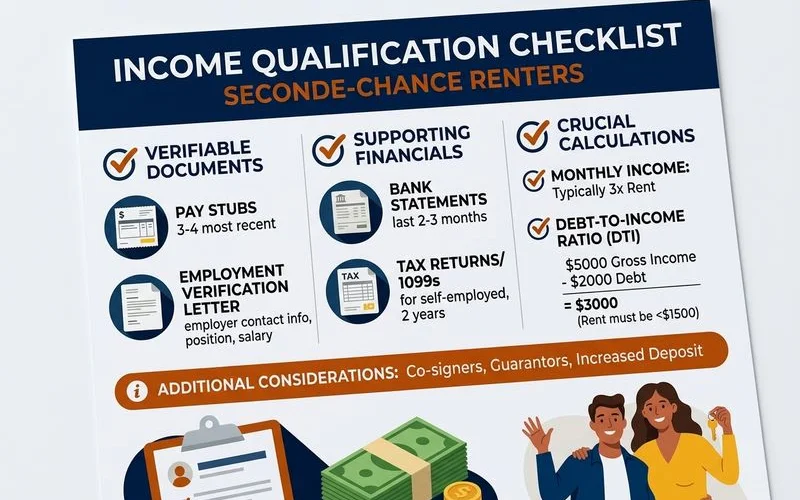
We require our clients to gather a flawless paperwork package before they ever submit an application. A complete and highly organized set of documents strongly signals your financial stability to a leasing agent. The minimum required documentation for an income-based application includes:
- Four weeks of continuous pay stubs (List the most recent first and cover any variations in hours)
- An official employer letter (Must be on company letterhead detailing your job title, hire date, gross monthly income, and a supervisor’s direct phone number)
- A valid government-issued photo ID
Our team knows that self-employed renters or those needing a stronger application must provide extra proof. You should prepare the following supplementary documents to guarantee a smooth process:
- Full bank statements for the last two to three months (Showing deposit patterns that perfectly match your stated income)
- Complete tax returns for the last one to two years (Essential for 1099 workers)
- Profit and loss statements (Highly recommended if you operate a small business)
- Benefit award letters (For Social Security, disability, or pension funds)
- Official court orders (Required to claim child support or alimony)
Property managers often fast-track approvals when you hand over a comprehensive file on day one.
We always suggest downloading official statements directly from your bank portal rather than providing screenshots. Screenshots are frequently rejected under the latest 2026 compliance standards because they are too easy to alter. Taking the time to gather PDF documents saves you from frustrating delays during the final review.
Debt-to-income (DTI) considerations
We constantly remind applicants that your gross earnings are only half of the financial equation. Many strict communities also calculate your debt-to-income ratio to compare your monthly obligations against your paycheck. Property managers need proof that your existing credit cards, car loans, and student debt leave plenty of room to pay the rent.
Our rule of thumb is to keep total debt payments completely under 40% of your gross income, including the proposed new rent. If you earn $4,000 per month, your combined debt and a $1,200 apartment should ideally sit below $1,600. In the 2026 Austin market, skyrocketing auto loan payments frequently push renters over this critical 40% threshold.
High auto loans and minimum credit card payments are the top reasons Austin renters fail the debt-to-income check, even when their salary easily covers the rent.
We see a massive advantage for renters who recently completed a bankruptcy discharge. Your personal DTI ratio often looks vastly better on paper because those discharged debts no longer demand a monthly payment. You must ensure the leasing agent runs a fresh calculation that accurately reflects your post-discharge financial state.
Self-employment income strategies
We regularly coach entrepreneurs and gig workers on how to overcome the common assumption that their income is too unstable. Self-employed renters face a much higher level of scrutiny during the background check phase. You can successfully bypass these hurdles by providing an overwhelming amount of undeniable proof.
Our suggested strategy relies on submitting a few specific documents that build absolute trust with the landlord:
- Two consecutive years of tax returns (Always preferred over just a single year)
- Three months of bank statements (Must show consistent monthly deposit ranges)
- Formal profit and loss statements (Ideally prepared by a certified bookkeeper or accountant)
- Active contract or recurring-client letters (Proves you have stable, ongoing revenue sources)
- A detailed letter of explanation (Crucial if your work varies seasonally, such as construction or real estate)
The majority of flexible Austin communities gladly accept self-employment earnings at the same multipliers as standard W-2 wages. Freelance invoices also provide excellent supporting evidence when paired directly with matching bank deposits.
We highly recommend gathering this entire portfolio before you even schedule a property tour. Taking a proactive approach prevents the property from holding your application in a pending status for days while waiting for updates. Clean documentation is the ultimate key to securing an instant approval.
How we pre-screen for income-based fits
We take all the guesswork out of the equation by matching your exact financial profile to the right property guidelines. Supplying your basic information on our intake form allows the system to filter out guaranteed rejections. The final result is a highly customized list of communities whose approval policies perfectly align with your specific situation.
Our clients typically receive a hand-picked list of available communities based on three key factors:
- Your gross monthly income
- Your target monthly rent
- Your current credit band
These matches represent locations where you hold a very high likelihood of approval based purely on your proven earnings. Bypassing the trial and error process saves you hundreds of dollars in wasted application fees.
We are ready to help you secure a great home today. Stop guessing and start packing. Ready for a list of income based apartments Austin locals trust, matched to your situation? Request your free list →
Frequently asked questions
How much income do income-based communities want?
Generally 2.5x to 3x the monthly rent in gross income. Income-focused properties often weight income over credit score, so strong income is the lever.
What counts as proof of income?
Pay stubs (4 weeks), an employment letter, bank statements, tax returns (for self-employed), and benefit award letters.
What if I'm self-employed?
Tax returns (last 1-2 years) plus bank statements document self-employment income. We target the flexible communities that accept this documentation.
Ready for a curated bad credit list?
Tell us your situation. We'll send a list of Austin apartments that will approve you — in 24-48 hours, free, no upfront fees.
Get Your Free List