Apartments That Accept Bad Credit in Austin
Which credit bands Austin properties accept, income-based alternatives, and how a curated list saves wasted fees. Get matched to flexible communities.

We see the same frustration constantly: renters spending $80 on application fees for properties that automatically deny their scores. That blind application process is a fast way to drain your bank account. Automated screening software like SafeRent often rejects applicants before a human leasing agent even looks at the file.
Our team at Austin Second Chance Apartments specializes in finding real housing solutions for Texas renters, especially those searching for bad credit apartments austin.
The good news is that the market for second-chance housing is much broader than most people realize. Recent 2026 market data shows citywide vacancy rates hovering near 9.7%, forcing many landlords to negotiate.
We will break down exactly what property managers evaluate, how income changes the equation, and the specific strategies that secure a lease. This exact knowledge saves applicants hundreds of dollars in wasted fees.
What “bad credit” actually means in apartment screening
What exactly qualifies as bad credit for an Austin rental? A score below 600 usually triggers an automatic denial at strict properties, while anything under 650 requires a specific strategy.
We constantly review screening criteria to understand how different properties assess financial risk. Property managers actually use several different scoring models instead of a single universal number. A 2026 industry report indicates the average credit score for a US renter is around 650.
Our clients are often surprised to learn that their standard FICO score is not the only metric being checked.
- FICO score (most common, 300-850 range)
- VantageScore 3.0 or 4.0 (similar range, different methodology)
- TransUnion ResidentScore (rental-specific risk score, 350-850)
- Experian’s RentBureau (tracks rental payment history specifically)
Each property configures its screening software with a unique minimum score. These minimum thresholds shift significantly depending on the specific community and current vacancy rates.
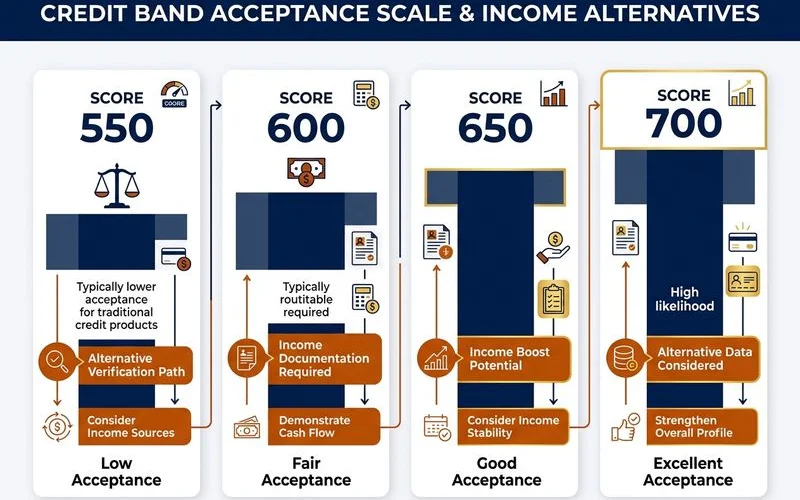
We categorize these common credit bands to help renters understand their market access:
- 750+ : “excellent”, preferred at most properties
- 650-749: “good”, standard market access
- 600-649: “fair”, many strict properties decline, mid-tier flexible accepts
- 550-599: “poor”, auto-denied at strict, income-focused flexible accepts with strong income
- Under 550: “very poor”, narrow pool, income-focused with 3x income and often a guarantor
A “fair” score at a brand new complex might be considered “great” at an older property down the street. Our locating experts use these exact bands to match you with a property that fits your profile.
What credit bands bad credit apartments Austin accept
Which specific properties in the city will work with a lower score? The older garden-style communities in South Austin and mid-tier suburban complexes are by far the most flexible.
We actively track acceptance patterns across the city to prevent our clients from wasting money on fees. The average rent in Austin sits around $1,616 as of early 2026. High vacancy rates have pushed some institutional landlords in North Austin to relax their hard 650 minimums down to 620 just to fill empty units.
Our data shows exactly where to look based on these typical credit-acceptance behaviors:
- Class A luxury / new high-rise (Downtown/Rainey St): usually 650-700 minimum, strictly enforced
- Mid-tier institutional (The Domain/NW Austin): usually 600-650 minimum, with income offset possible
- Older garden-style (Central/South Austin): often 550 or no hard floor, heavily income-weighted
- Suburban newer mid-tier (Buda, Kyle, Manor, Pflugerville): often 580-620, income-weighted
- Voucher-friendly and income-restricted: usually no hard credit floor, income-weighted
The largest pool of low credit apartment austin options exists along the East Austin Riverside corridor. Expanding your search into the suburban rings gives you access to newer properties with lenient criteria.
We find that flexibility increases the further you move away from the dense luxury downtown core.
How income substitutes for credit
How can a high paycheck make up for a low credit score? Property managers will often ignore a 550 score if you can prove your monthly gross income is three to four times the monthly rent.
We see this income offset work successfully for dozens of applicants every single week. Income-focused properties weigh your earning power far more heavily than past financial mistakes. The standard rent-to-income ratios look like this:
- 2.5x rent at the flexible end (income covers rent 2.5 times over)
- 3x rent at the standard end
- 3.5x rent at the stricter end
A renter with a 540 credit score and $5,000 in monthly income applying for a $1,400 apartment is a very strong applicant. That 3.57x ratio provides a landlord with far more security than a 680 score with only $3,500 in monthly income.
Our team uses this exact math to advocate for clients during the application process. Third-party guarantor services like Leap or The Guarantors can also bridge this gap for a fee of around one month’s rent. The numbers usually work in favor of strong, verifiable income.
We encourage everyone to read our full breakdown on credit score vs income in apartment screening for more details.
What about derogatory items beyond just a low score?
Do landlords look at specific negative marks rather than just the three-digit number? Yes, screening software flags open property management debt and recent evictions as major dealbreakers.
We frequently remind renters that the score is merely a summary of their financial history. The underlying items on your report dictate whether a flexible landlord will approve the application. Travis County processed over 13,000 eviction filings recently, making rental history the most scrutinized section of any application.
Our experience shows that different types of debt are treated with varying levels of severity:
- Open collections: handled separately from the score, many properties have a strict $500 maximum balance threshold.
- Discharged bankruptcy: often weighted more favorably than an open, active derogatory debt.
- Medical debt: frequently ignored completely by modern screening algorithms.
- Charge-offs: read differently from open balances and are usually considered less severe.
- Recent foreclosure: see renting after bankruptcy or foreclosure in Austin.
A leasing agent will review your full credit report alongside the raw score when you apply. Past due balances to a previous apartment complex will stop almost any application instantly.
We strongly advise paying off old property management debt before attempting to rent a new place.
Strategy by credit band
What is the best way to apply based on your specific score? You must target the right property tier and offer upfront income proof to avoid wasted application fees.
Our locating strategy revolves around matching the applicant’s exact profile to the most receptive property type. Blindly applying to luxury units with a 550 score is a guaranteed rejection. The table below outlines the most effective approach for different credit situations.
| Credit Score Band | Primary Target Property | Recommended Income Proof | Key Strategy |
|---|---|---|---|
| Score 600-650 | Central Austin mid-tier | 3x monthly rent | Standard application strategy works. Skip Class A luxury. |
| Score 550-599 | Income-focused older garden-style | 3x to 3.5x monthly rent | Lead with income on the phone. Do not apply blind. |
| Score under 550 | Suburban mid-tier or private landlords | 3.5x rent or Guarantor | Pre-screening is mandatory. Expect to pay a higher deposit. |
Most successful placements for apartments accept bad credit austin happen in the 550 to 599 band when the applicant has strong income. Renters under 550 face a narrow but very real pool of housing options.
We focus heavily on pre-screening these sub-550 applications to protect our clients’ funds.
What to prepare before applying
What exact documents do you need to secure an approval? You must have recent pay stubs, bank statements, and a valid ID ready to submit the moment you find a flexible unit.
Our team recommends gathering all paperwork before you ever schedule a property tour. Speed is critical when dealing with highly sought-after second-chance units. Property managers are increasingly using software like Snappt or Plaid to verify income and detect altered documents.
We tell every client to prepare the following items for a credit-flexible application:
- 4 weeks of unedited pay stubs (most recent)
- Employer letter with title, hire date, and monthly gross income
- Bank statements (last 2-3 months, which is highly useful if self-employed)
- Valid Government ID
- Guarantor pre-approval documentation (if needed)
- Explanation letter for any specific derogatory items (medical hardship, divorce, 2024 layoff)
Some communities gladly accept a factual letter of explanation for past derogatory marks. A short, honest note stating that a 2024 medical emergency caused late payments can shift a borderline case into an approval.
We love seeing applicants take control of their narrative by explaining their situation clearly.
Finding bad credit apartments austin takes effort, but you do not have to do it alone. Gathering your documents and understanding your score is the perfect first step.
Ready to get matched to credit-flexible Austin communities? Request your free list →
Frequently asked questions
What credit score do Austin apartments require?
It varies. Many credit-flexible communities weigh income over score — meaning strong income at 3x rent can clear screening at properties that auto-deny stronger credit with weaker income.
Can I rent with a score under 500?
Often yes at income-focused complexes with strong proof of income. A guarantor program can also bridge gaps if your income is borderline.
How do I avoid wasting application fees?
Apply only to pre-screened communities from a curated list. Blind applications at strict properties are how low-credit renters lose $200-$400 in fees.
Ready for a curated bad credit list?
Tell us your situation. We'll send a list of Austin apartments that will approve you — in 24-48 hours, free, no upfront fees.
Get Your Free List