Income & Guarantor Requirements After an Eviction
Most Austin communities want 2.5x-3x income and a guarantor after an eviction. The financial bar, guarantor costs, and what to prepare.

We review hundreds of applications every month, and the financial side of approval always matters more than the eviction itself.
Communities that work with second-chance renters need to see enough income to cover rent reliably. They also require some form of offset for the perceived risk.
Our team wants to show you exactly what the income requirements to rent after eviction look like right now.
This guide will explain exactly how to clear that bar.
The 2.5x to 3x rule for income requirements to rent after eviction
Most Austin communities use an income-to-rent ratio as a primary screening filter for second-chance rentals.
- Standard: 2.5x or 3x gross monthly income vs. monthly rent
- Stricter (often post-eviction): 3x or 3.5x
- Income-focused communities: Usually 2.5x as the floor
Average Austin rents are sitting around $1,636 a month in 2026. If you find a slightly cheaper $1,500/month apartment, the math breaks down clearly:
| Required Ratio | Gross Income Needed |
|---|---|
| 2.5x | $3,750 / month |
| 3x | $4,500 / month |
| 3.5x | $5,250 / month |
Gross income means your earnings before taxes and deductions. Properties want to see this proven through official documents rather than raw bank deposits. We always tell clients that property managers calculate this strictly down to the dollar. You cannot round up your salary to hit the required rental income multiple after eviction.
What counts as income
Most communities will accept standard, verifiable forms of income:
- W-2 employment income (pay stubs from the last 4-8 weeks)
- 1099 or self-employment income (tax returns from the last 1-2 years plus bank statements)
- Social Security or disability benefits (award letter)
- Pension or retirement income (1099-R or benefit statement)
- Child support or alimony (court order plus deposit history)
- Housing Choice Voucher (Section 8 award letter, counts toward the rent calculation)
Many will not accept:
- Unreported cash income
- Friends’ or family members’ income (unless they sign the lease)
- Future income not yet started (a job offer alone is weaker than 4 weeks of pay stubs)
Our agents have seen a massive shift in how properties verify these documents in 2026. Many Texas complexes now run application files through AI software like Snappt or ApproveShield. These platforms analyze thousands of data points to catch forged pay stubs instantly. Using a fake document generator will result in an immediate denial and blacklisting.
We highly recommend connecting directly to your employer’s payroll system if the application portal allows it. This simple step bypasses manual review and speeds up your approval by days.
How a guarantor requirement post eviction changes the math
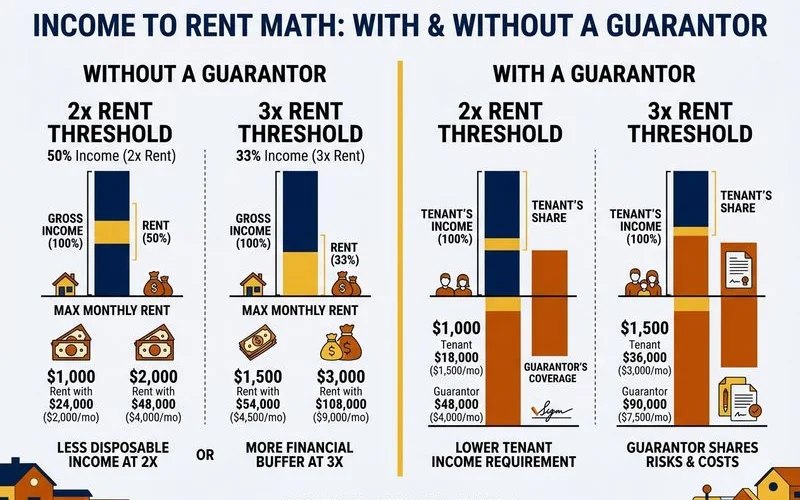
A third-party guarantor typically reduces the effective income requirement by 0.5x. Companies like LeaseLock, Rhino, and TheGuarantors act as your financial backer. We frequently use these programs to help clients bridge the income gap. A property requiring 3x rent might accept 2.5x if you use one of these services.
The guarantor fee is typically about one month’s rent, paid once at lease signing. For our $1,500/month example, the difference looks like this:
| Scenario | Income Required | Guarantor Fee |
|---|---|---|
| Without Guarantor (3x) | $4,500 / month | $0 |
| With Guarantor (2.5x) | $3,750 / month | ~$1,500 one-time |
If your gross income is $3,500/month and the property wants 3x ($4,500), you fall short. A guarantor at 2.5x ($3,750) closes that gap quickly. Our experience shows that the one-time fee is usually less than the massive difference in rent you would pay at a lower-tier property.
The deposit question
Most communities apply a higher security deposit to applicants with an eviction history. Common patterns look like this:
- Standard deposit: usually 1x monthly rent (or a flat $200 to $500)
- Eviction-flagged deposit: often 1.5x or 2x monthly rent
We want to highlight a crucial Texas law regarding this process. Texas has no statutory limit on how much a landlord can charge for a security deposit. This gives property managers full legal flexibility to ask for double or triple the standard amount based on your rental background.
With a guarantor, the community sometimes drops back to the standard deposit level. Without one, you should plan your budget around the higher eviction-flagged amount.
For more on the guarantor side specifically, see how guarantor and co-sign programs work.
What to actually prepare
For an eviction file, bring these specific items to every single application:
- 4 weeks of pay stubs: Most recent first.
- Employer letter: Printed on company letterhead with your job title, hire date, gross monthly income, and supervisor’s direct phone number.
- Bank statements: Bring the last 2-3 months to help if you are self-employed or if your income is borderline.
- Government ID: A driver’s license or state ID.
- Guarantor pre-approval: Print this from Rhino, LeaseLock, or TheGuarantors if you need one.
- References: Contact info from a non-evicting prior landlord or current employer.
Our team suggests having all of this organized before you even step foot on a property to tour. Having digital copies ready on your phone signals stability to the leasing agent. It also prevents delays if they need to run your file immediately.
We often see approvals happen twice as fast when applicants provide their supervisor’s direct extension rather than a general company hotline. Property managers will verify employment, so make sure your references expect a call.
What to do if you don’t clear the bar
A few realistic options exist if your income is below 2.5x, even with a guarantor.
- Find a roommate: Combined incomes often clear the threshold easily.
- Target a lower rent: Drop your monthly target by $200 and the math changes immediately.
- Look in suburbs: Moving to nearby towns creates a huge advantage.
- Wait 2-3 months: If your income just changed, give it some time to show up on your pay stubs.
Our data shows that moving just 20 minutes south to Kyle can drop your rent significantly. Average 2026 rents in Kyle are sitting around $1,177, compared to Austin’s $1,636 average. That $450 difference completely changes your required income multipliers. The size of the gap also depends on how recent your eviction is — if yours is under a year old, see which Austin apartments accept evictions under 1 year old for the narrower-but-real options.
We always stay upfront when your budget falls short of the income requirements to rent after eviction. If placing you is not realistic right now, the team will tell you the exact gap and what steps will close it. Our eviction apartment locator service pre-screens which communities will accept your income and guarantor setup before you spend a dollar on fees. Request your free list →
Frequently asked questions
How much income do I need after an eviction?
Most flexible communities want 2.5x-3x the monthly rent in gross income. After an eviction, stricter properties may push to 3.5x or require a guarantor.
What if my income is just short?
A third-party guarantor (about one month's rent in fees) typically bridges a gap of up to 0.5x in income. Several services work in Austin.
Will my deposit be higher?
Often yes. Many communities double the standard deposit after an eviction. A guarantor sometimes reduces this back to standard.
Ready for a curated eviction list?
Tell us your situation. We'll send a list of Austin apartments that will approve you — in 24-48 hours, free, no upfront fees.
Get Your Free List