How to Rent an Apartment With an Eviction in Austin
A realistic path to approval after an eviction in Austin: documents to gather, how locators pre-screen properties, and what to expect on income and guarantor.

We know exactly how frustrating it feels to hit a brick wall during your apartment hunt. Renting with past evictions in Austin feels like the market is completely closed off to you.
From what we see every day, that door is actually still open.
The current 14.2% vacancy rate across the city means property managers are more willing to negotiate than they were two years ago, based on recent data from Matthews Real Estate Investment Services. You can still get approved if you approach the process strategically.
Our team is going to break down the exact eviction rental documents Austin property managers require, which neighborhoods are currently the most flexible, and how to structure your conversation with leasing agents.
Step 1: Know what your record actually looks like
We always tell our clients to start by pulling their actual rental history report from Experian RentBureau. Seeing exactly what the leasing manager sees prevents you from wasting money on doomed applications.
In Austin, apartment application fees easily average $50 to $100 per adult, according to Hoozzee’s 2026 rental guide. Applying blind to five complexes could cost you $500 before you even get a callback.
We highly recommend securing your own data first to protect your budget. Most apartment screening software looks back seven years at public court records. A Travis County Justice of the Peace eviction filing will stay visible on your background check even if you eventually paid the balance.
Here is what you need to verify on your own background check:
- Filing vs. Judgment: Did the landlord just file, or did the judge rule against you?
- Outstanding Balances: Is there a specific dollar amount still showing as owed?
- Categorization: How did your most recent property report your move-out status?
Step 2: Map the right properties
The secret to figuring out how to rent after eviction is targeting properties that run their own manual screening instead of relying on automated software. Certain neighborhoods and building types are significantly more forgiving than others.
We maintain an active database of these flexible communities. Austin is currently seeing a surge in apartment supply, pushing the citywide vacancy rate to around 14.2% in 2026. This high vacancy means landlords in competitive suburbs are much more willing to work with complicated backgrounds.
The properties most likely to approve a renter with an eviction fall into a few clear categories:
- Older garden-style complexes: Look for owners with long tenures who personally review applications.
- Newer mid-tier construction: Suburbs like Round Rock, Pflugerville, Buda, and Kyle are fighting for tenants right now.
- Specific central corridors: The Riverside corridor, South Lamar, and parts of North Austin have pockets of flexibility.
- Voucher-friendly complexes: Properties in East Austin and South Austin often have different risk profiles.
We can help you find these exact spots. Each building has unadvertised rules regarding how recent your eviction was and whether you carry rental debt. The eviction apartment locator service we provide pre-screens these exact requirements for you.
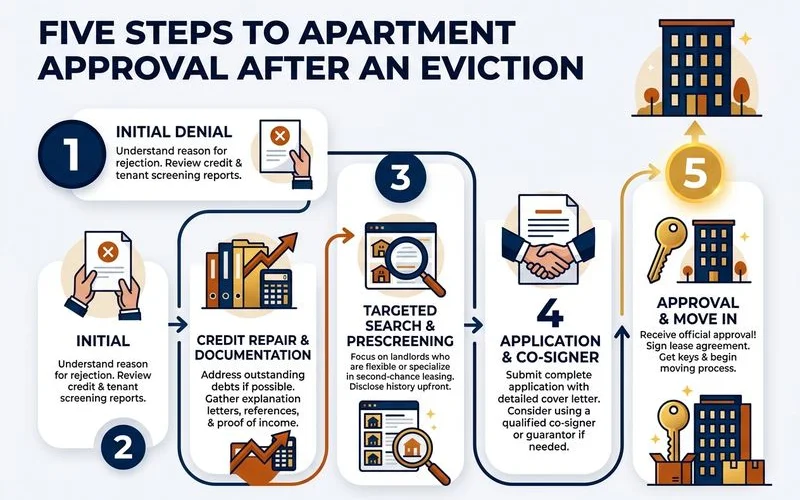
Step 3: Gather your documents before you apply
We advise gathering every piece of financial documentation before you schedule a single tour. Having your paperwork perfectly organized signals stability to a property manager who is taking a chance on your application.
The standard requirement in Austin is proving your gross income is 2.5 to 3 times the monthly rent. The average one-bedroom apartment in Austin costs about $1,410 right now, according to Apartments.com 2026 market data. You will need verifiable pay stubs showing roughly $4,230 in monthly earnings to comfortably qualify for a standard unit.
We recommend preparing a very specific folder of documents. For an eviction file, the documentation that matters most includes:
- Proof of strong income: Recent pay stubs covering four weeks, plus a signed employment verification letter.
- Identity verification: A government-issued ID and Social Security number for the mandatory background check.
- Banking history: Your last two to three months of bank statements if you are self-employed or your income is borderline.
- Guarantor pre-approval: Confirmation from services like Rhino, LeaseLock, or TheGuarantors. You can review the details on income and guarantor requirements after an eviction.
- Character references: Letters from a current employer or a non-evicting previous landlord.
We see applications get approved much faster when this entire package is handed over immediately. It saves a week of frustrating emails and proves you are a serious, organized candidate.
Step 4: Disclose strategically
We teach our clients to disclose their eviction upfront over a quick phone call before paying any fees. Confirming the property will actually work with your specific situation is the smartest way to protect your application budget.
Almost every property in Austin uses the standard Texas Apartment Association rental application. This form includes a mandatory question asking if you have ever been evicted or asked to move out. Lying on this application is immediate grounds for rejection.
We suggest using a very direct script when you call the leasing office. A short phone call before touring saves everyone time:
“I have an eviction from 2024. My income is $4,200 a month. Will your property work with that?”
You can find exact phrasing in the guide on how to talk to leasing agents. If the agent says yes, you can confidently tour and apply knowing your history is already on the table. If they say no, you simply keep your money and move to the next property.
Step 5: Plan for a higher deposit or a guarantor
We always prepare our clients to pay a higher move-in cost to offset the landlord’s perceived risk. Even the most flexible communities will want financial reassurance before handing over the keys.
The Texas Property Code does not place any legal cap on security deposit amounts, as highlighted by Campus Realtors. This lack of restriction means a landlord can legally ask you for double the standard deposit if your background check shows an eviction.
We typically see landlords request one of three specific financial offsets:
- Increased security deposit: Often 1.5 to 2 times the standard amount, which remains refundable at move-out.
- Third-party guarantor: A non-refundable fee paid to a company that co-signs your lease.
- Prepaid rent: Asking for the last month of rent paid upfront in cash.
A custom review of your specific numbers happens when you receive your curated list of properties. A guarantor is usually the cheapest immediate path if cash is tight, while a larger deposit is the simplest solution if you have savings.
What’s realistic by eviction age
We use the actual age of your eviction to determine which tier of apartments you can access. The older the court filing, the easier it is to negotiate a standard lease agreement.
Time heals most rental records in the eyes of property management companies. The seven-year mark is the primary goal, as this is when the public record typically falls off standard background checks completely.
We built this breakdown to show you exactly what to expect based on how much time has passed since your court date.
| Eviction Age | Market Access Level | Typical Requirements & Income Needed |
|---|---|---|
| Under 1 year | Very narrow but possible | Third-party guarantor usually mandatory; strict 3x income proof required. |
| 1 to 2 years | Expanding pool of options | Many properties will consider you with a standard 3x income ratio. |
| 2 to 6 years | Approaching standard access | Standard deposits often apply; minor restrictions on luxury properties. |
| 7+ years | Full market access | The eviction rarely surfaces in standard Austin apartment screening software. |
Finding communities that accept extremely recent filings requires constant monitoring. For the recent end of that range, see do Austin apartments accept evictions under 1 year old?.
Ready for a curated list of eviction-friendly Austin properties? Request your free list →
Frequently asked questions
Can I rent right after an eviction?
Options are limited within the first year but they exist. The pool widens noticeably after one year, and again after two years. Strong income and a guarantor help most.
What documents help most?
Proof of income at 2.5x–3x rent, an employment letter, and references from previous (non-evicting) landlords or employers.
Will I need a bigger deposit?
Often yes after an eviction. A third-party guarantor can sometimes reduce the deposit by offsetting the community's perceived risk.
Ready for a curated eviction list?
Tell us your situation. We'll send a list of Austin apartments that will approve you — in 24-48 hours, free, no upfront fees.
Get Your Free List