Renting With a Misdemeanor or Deferred Adjudication
How misdemeanors screen vs felonies, what deferred adjudication means on a background check, documentation to obtain, and what to expect.

If your record is a misdemeanor or a deferred adjudication, you’re in a noticeably easier position than someone with a felony conviction. Both screen more leniently across most flexible-screening Austin communities. Here’s exactly how each is treated, and what documentation helps.
Misdemeanors: how they screen
Texas misdemeanors are categorized as Class A, B, or C:
- Class C misdemeanors (traffic tickets, public intoxication, disorderly conduct, low-level theft) often don’t surface in standard apartment background checks at all. Many screening services filter them out as low-relevance.
- Class B misdemeanors (first-time DWI, possession of small amounts of certain drugs, criminal mischief under $750) typically surface but are treated leniently, especially after a few years.
- Class A misdemeanors (assault without serious injury, certain theft, second DWI, weapons charges) surface and may trigger flags, but flexible communities often work with them — especially older offenses.
For misdemeanors generally:
- Under 7 years: surfaces in screening; case-by-case communities work with them, especially non-violent
- Over 7 years: often filtered out by standard screening; effectively cleared from most flagging
Misdemeanors are usually a much smaller obstacle than they feel like. We’ve placed plenty of renters with multiple misdemeanors at standard market communities without issue.
Deferred adjudication: the nuanced case
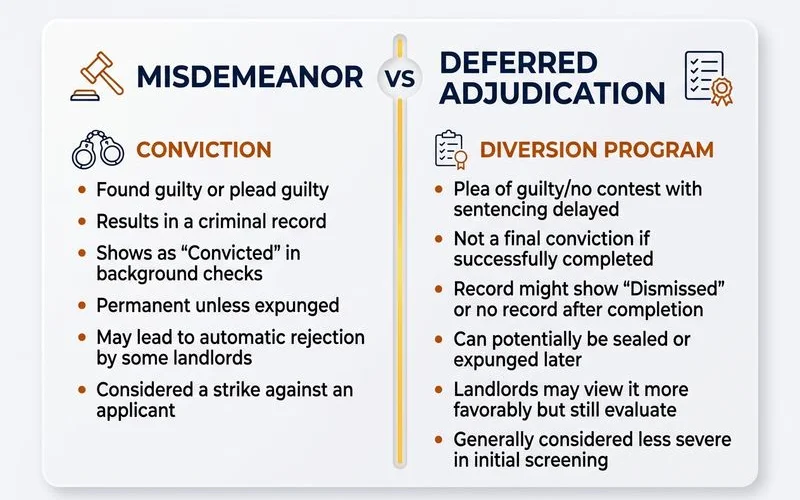
Deferred adjudication is a Texas-specific outcome where you plead guilty or no contest but the judge defers a finding of guilt while you complete a probation period. If you complete the probation successfully, the case is dismissed and no conviction is entered.
But here’s the catch: the original charge and the deferred adjudication record can still appear on a background check, even after completion. This is because:
- The arrest record exists
- The court file shows the charge was filed and how it was disposed
- Standard background searches see “deferred adjudication” rather than “conviction”
How apartment screening typically treats it:
- Successfully completed deferred adjudication: weighted much more leniently than a conviction. Many flexible communities essentially treat it as a non-event.
- Currently in deferral period: depends on the property. Some treat it as a pending case; others ignore it.
- Failed deferral (revoked to conviction): treated as a conviction, with all the implications that come with it.
Orders of non-disclosure
Texas allows certain deferred adjudication outcomes to be sealed via an order of non-disclosure, which hides the record from most landlords’ background checks. The order is granted after specific waiting periods (typically 2-5 years post-completion, depending on the offense type).
If you’re eligible and haven’t pursued one, it’s worth doing:
- The record stays hidden from standard background checks, including apartment screening
- Law enforcement and certain entities can still see it (DAs, schools hiring teachers, etc.) but not regular landlords
- The cost is filing fees (varies by county) plus optional attorney help
Texas RioGrande Legal Aid and the Texas Fair Defense Project offer help with non-disclosure petitions for eligible cases. For some renters, this is the single highest-ROI move they can make for their rental prospects.
What documentation to bring
For a misdemeanor or deferred adjudication file:
- Court disposition document showing the official outcome (completion, dismissal, deferral)
- Probation completion certificate if applicable
- Order of non-disclosure if you have one (powerful — many properties will skip the screening detail entirely)
- Brief explanation letter providing context (one paragraph; not required but often helpful)
- Standard income documentation at 3x rent or higher
Strategy by case type
Class C misdemeanor only: most properties won’t see it. Apply broadly without concern. Don’t volunteer the information unless asked.
Class A or B misdemeanor, older than 5-7 years: most standard mid-tier properties work. Apply across the credit-flexible market.
Recent misdemeanor (under 3 years): target case-by-case communities; lead with the offense type and age on the phone before applying.
Completed deferred adjudication, not non-disclosed: target flexible-screening properties; bring completion documentation. Many properties treat this as a non-event.
Completed deferred adjudication with order of non-disclosure: most properties effectively don’t see it. Apply broadly.
Currently in deferral period: depends on the property; pre-screening matters.
Misdemeanor vs. felony for apartment screening
Five practical differences:
- Lookback weight: misdemeanors typically weighted less than felonies of the same age
- Filtering: Class C misdemeanors often filtered out entirely; felonies always show
- Documentation: misdemeanors usually need less documentation; felonies often need rehabilitation letters
- Property pool: misdemeanors have a larger pool of available properties
- Guarantor: misdemeanors less likely to require a guarantor; felonies often do
If your record is a misdemeanor or completed deferred adjudication, you’re meaningfully better positioned than the typical second-chance applicant. Pre-screening still matters (saves application fees), but the overall pool is wide.
Ready for a curated list of Austin apartments matched to your specific case? Request your free list →
Frequently asked questions
Does deferred adjudication show on a background check?
It can appear unless sealed via a Texas order of non-disclosure. Even when it appears, deferred adjudication is generally treated more leniently than a conviction.
Are misdemeanors easier than felonies for renting?
Generally yes. Misdemeanors screen more leniently across most flexible communities. Class C misdemeanors often don't surface in standard screening at all.
Can I get my record non-disclosed?
Sometimes — depending on offense type and waiting period. An order of non-disclosure can hide the record from most landlords' background checks.
Ready for a curated background list?
Tell us your situation. We'll send a list of Austin apartments that will approve you — in 24-48 hours, free, no upfront fees.
Get Your Free List