Apartments That Accept Felonies in Austin
Which Austin property types accept felonies, the age and offense-type factors that matter, and how a locator pre-screens. Get a free curated list.

You know the frustration of paying a hefty application fee, only to get an automated rejection letter days later. Our team sees this happen to qualified renters searching for apartments that accept felonies austin every single week.
The screening process feels rigged against anyone with a past. Finding housing with a record requires strategy and an understanding of specific property policies.
We help clients secure approvals by targeting communities that review the actual person. The local rental landscape shifted significantly in 2026. High vacancy rates mean more landlords are willing to negotiate.
Let’s examine the exact screening factors, lookback periods, and the application approaches that actually work right now.
The short answer
Yes, Austin apartments accept felonies, especially non-violent offenses outside the standard Texas background window. The applicant pool narrows for newer offenses and for specific violent or registry-bound crimes. Options still exist throughout the city.
Our locators track these shifting market conditions daily to find the best opportunities. The 2026 Austin apartment vacancy rate sits around 13.5 percent. This elevated vacancy rate means property management companies using software like RealPage or RentGrow are adjusting their filters. They need to approve more case-by-case applications to fill empty units.
Properties generally fall into three distinct buckets:
- Properties that ignore your record entirely because the timeframe falls outside their required lookback limit.
- Properties that do case-by-case review of records within their lookback limits.
- Properties with blanket bans that automatically deny any record regardless of context.
We focus our efforts entirely on the first two categories. A softer rental market creates powerful leverage for renters with records.
Which property types accept felonies
Older garden-style properties and voucher-friendly communities are your best bet for an approval. The Austin/Travis County Reentry Roundtable publishes a widely used screening guide. This guide actively pushes local landlords to cap felony background checks at seven years.
Our agency maps the entire city to locate the management groups adopting these fairer guidelines. Properties utilizing City of Austin Rental Housing Development Assistance funds are actually required to use case-by-case screening. They cannot issue automatic bans.
A rough map of Austin inventory shows where you have the highest likelihood of approval:
- Older garden-style complexes (South Austin, East Austin) offer the most flexibility, as many perform their own screening with case-by-case review.
- Newer suburban mid-tier (Pflugerville, Manor, Buda) often provide flexible terms for non-violent offenses backed by solid documentation.
- Voucher-friendly properties usually follow HUD guidance that discourages automatic blanket denials.
- Independent / boutique mid-rise buildings have variable policies but frequently offer case-by-case assessments.
- Class A luxury apartments remain extremely strict and are generally not a realistic target.
- Large institutional portfolios often enforce rigid blanket policies.
We find the highest success rates at properties performing individualized assessments.
| Property Type | Screening Policy | Approval Odds |
|---|---|---|
| Private Garden-Style | Manual Case-by-Case | High |
| RHDA Funded Units | Regulated 7-Year Cap | High |
| Class A Luxury | Automated Blanket Ban | Low |
What “non-violent” means in screening
Non-violent offenses typically include drug possession, theft, property crimes, and fraud. The largest pool of flexible communities works with these specific charges. Violent crimes and offenses requiring Megan’s Law registry trigger automatic denials at roughly 95 percent of mainstream properties.
Our team categorizes your specific background to match you with the right felony friendly apartments austin. Apartment screening software generally distinguishes between several distinct categories. The U.S. Department of Housing and Urban Development continues to advise landlords to perform individualized reviews rather than instant rejections.
Here is how properties typically view different backgrounds:
- Non-violent felonies: drug, property, theft, fraud, and most other offenses.
- Violent felonies: usually treated much more strictly, resulting in fewer flexible options.
- Sex offenses: very narrow pool, often locked out at most properties due to registry rules.
- Federal offenses: handled strictly property-by-property.
- Class A misdemeanors: similar to non-violent felonies, but the Reentry Roundtable suggests landlords only look back three years.
- Deferred adjudication: depends heavily on the final disposition status and whether the records are sealed.
We always remind clients that non-violent charges outside the standard lookback window present very few hurdles. The process becomes a matter of matching you with the right management company.
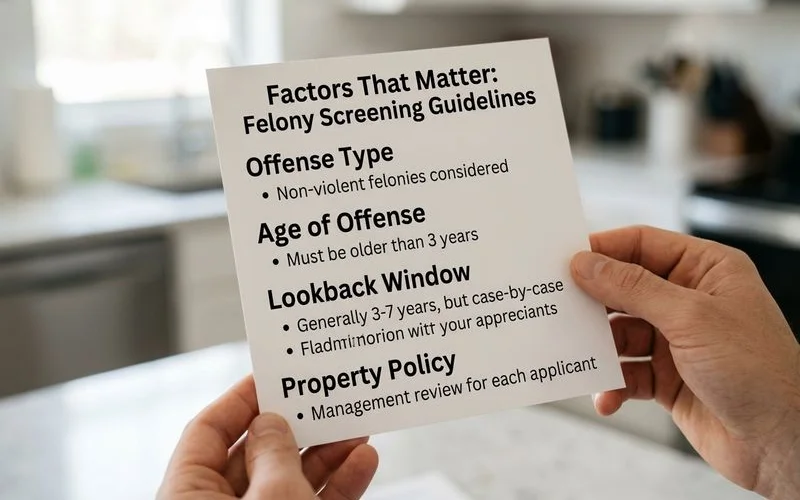
How the 7-year lookback shapes everything
The seven-year window dictates whether an offense even appears on a standard background report. Texas Business and Commerce Code § 20.05 prevents consumer screening agencies from reporting non-convictions or arrests older than seven years. Most apartment screening protocols use this exact same timeframe for convictions as well.
Our daily conversations with leasing managers confirm that the age of your offense is a critical strategic variable. Offenses outside this window often do not surface at all. Offenses inside the window will flag the system but can sometimes be overlooked by case-by-case communities.
The timeline impacts your options in the following ways:
- Over 7 years: pool is wide, encompassing most flexible properties and many standard ones.
- 5-7 years: pool is narrower but still real, with case-by-case properties being the most likely path.
- 3-5 years: requires a highly targeted application, focusing on non-violent charges and strong income.
- Under 3 years: narrowest pool, requiring specific case-by-case communities and often a guarantor.
We highly recommend reviewing the full legal breakdown in the Texas 7-year background lookback explained. This knowledge prevents you from volunteering disqualifying information unnecessarily.
What documentation helps
A complete documentation package proves your current stability and overrides the risk flagged by the screening software. Supplying a letter from an employer or a completion certificate from the Travis County Reentry Success program adds massive credibility to your file. Providing proof of income at 3.5x to 4x the monthly rent significantly improves approval odds during a manual review.
Our agents use these exact documents to advocate for your application before the manager even runs your background.
A documented application package shifts case-by-case decisions heavily in your favor. You will need to gather the following items:
- Court disposition documents showing the exact resolution, especially for deferred adjudication or completed probation.
- A rehabilitation letter acting as a short, factual letter on what has changed regarding your employment and stability.
- Employment references from a current supervisor or a program coordinator at Goodwill Central Texas.
- Income documentation proving earnings at 3x the rent or higher to offset the perceived risk.
- Government ID and Social Security number to complete the standard identity verification.
We have seen strong income single-handedly turn a likely denial into an approval. For more on the documentation side, see how case-by-case criminal screening works.
Strategy by offense age
Your application strategy shifts entirely based on whether your offense is over seven years old or very recent. Different timeframes require completely different approaches to property selection and communication.
Our locators adjust their search parameters based on these exact aging milestones. The customized list of targets depends entirely on the specific timeframe of your disposition.
Offenses Older Than Seven Years
Non-violent charges older than seven years rarely block you from standard mid-tier properties. You can apply with confidence at credit-flexible communities throughout the city. Most screening software programs will not even pull the offense in their standard lookback report.
Offenses Between Five and Seven Years
The pool narrows slightly once your charge falls within the standard reporting window. You must target case-by-case communities located in suburbs like Manor or Buda. Solid documentation and a strong income are the primary levers you need to pull here.
Offenses Under Five Years
Pre-screening matters most for these newer charges. You must lead with your rehabilitation letter and income details on the phone before submitting an official application. Charges under three years often require a guarantor who makes five times the rent, along with a larger security deposit.
We will always be completely upfront about what is realistic for violent or sex offenses. These cases are highly specific and require a completely customized approach.
What about misdemeanors?
Misdemeanors carry significantly less weight than felonies and usually feature a much shorter lookback period. Many Austin properties limit misdemeanor background checks to just three years. A Class A or B misdemeanor that is a few years old often avoids triggering flags at most flexible communities.
Our clients are often surprised to learn how lenient properties can be with minor charges. Deferred adjudication cases that have been successfully completed and sealed will not appear on a standard tenant screening report at all.
| Charge Type | Standard Lookback Limit | Flexibility |
|---|---|---|
| Standard Misdemeanor | 3 Years | High |
| Standard Felony | 7 Years | Moderate |
We highly encourage applicants with minor records to read up on the specifics. For detailed strategies, see renting with a misdemeanor or deferred adjudication.
Our approach to apartments that accept felonies austin
We start with a confidential intake to map your specific background against property criteria before you spend a dime. Application fees run between $50 and $100 per adult in Austin right now. Wasting money on guaranteed denials is an exhausting and expensive process.
Our service eliminates the guesswork from finding an apartment for felons austin. Cases involving a record demand the most time-intensive work we do.
The typical placement process looks like this:
- Confidential intake covering your offense type, age, disposition, and move-in timeline.
- Mapping case-by-case properties against your specific charge and income level.
- A pre-call to a flexible property manager to frame your situation and gauge their willingness to work with you.
- Delivery of a curated list with notes on what documentation each property will demand.
We provide this locating service completely free of charge. There are absolutely no upfront fees or hidden costs. Request your free list →
Frequently asked questions
Can I rent an apartment with a felony in Austin?
Often yes for non-violent offenses, especially those outside the Texas 7-year lookback. Case-by-case communities will review newer offenses individually.
Which properties accept felonies?
Older garden-style stock, newer suburban mid-tier, and properties that do case-by-case screening rather than blanket bans. We pre-screen them for you.
Does the age of my offense matter?
Yes, significantly. Older offenses (outside the 7-year window) open the broadest pool. Newer offenses still have options at case-by-case communities.
Ready for a curated background list?
Tell us your situation. We'll send a list of Austin apartments that will approve you — in 24-48 hours, free, no upfront fees.
Get Your Free List